

Whether you are starting or running a business, the process can be complicated. There are lots of financial decisions to deal with, tax deadlines to meet, and compliance regulations to heed.
Choosing the correct accountant is essential to getting through the obstacles. But is it better to hire a tax accountant in Melbourne or a business accountant? What is the difference? Which one is a better fit for you? In this article, we will examine the role of tax accountants and business accountant in Melbourne.
Tax Accountant vs Business Accountant
What Does a Tax Accountant Do?
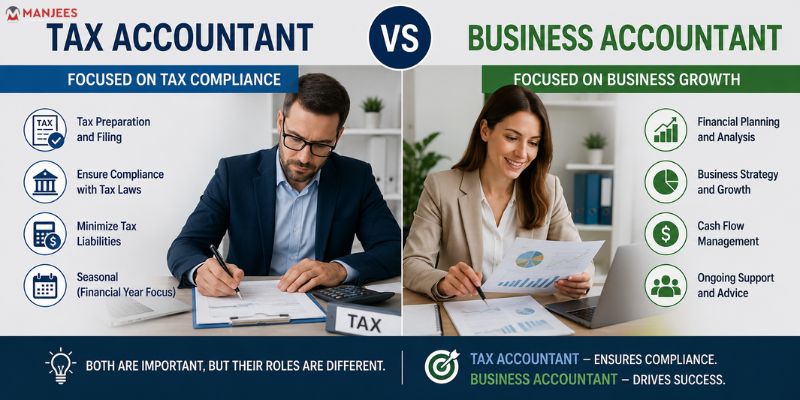
A tax accountant is a person who prepares and manages tax returns. The insure your business complies with the latest tax laws and help you minimize your tax liability legally. They handle:
- Personal and business tax returns
- GST registration and reporting
- BAS (Business Activity Statements)
- Tax planning strategies
- Audits and tax audits
- Tax advice around deductions and credits
Tax accountants are experts in tax law. They keep up with changes. You don’t face penalties or missed benefits.
What Does a Business Accountant Do?
A business accountant has to offer more financial services. The focus on managing your business finances. They plan for your growth and optimise profitability. They handle:
- Bookkeeping and financial statements
- Budgeting and cash flow management
- Business planning and strategy
- Financial analysis and forecasting
- Compliance and reporting
- Tax advice (but not just limited to tax)
Tax accountants focus mainly on tax compliance. Business accountants look after the overall health of your enterprise.
Some Interesting Facts
Many people assume that every accountant performs the same role. There are important differences between a Tax Accountant in Melbourne professional and a Business Accountant Melbourne expert. Understanding these differences helps you choose the right support at the right stage of your business.
According to the Australian Bureau of Statistics (ABS), around 97% of Australian businesses are small. Many struggle with financial planning during their first five years. Poor cash flow is one of the leading reasons businesses fail. This shows that choosing the right accounting professional is not simply about lodging tax returns. It is about building a financially healthy business.
Importance of Choosing the Right Accountant
Most of the business people consult their accountants only when it is time for tax returns. It means that chances of saving on taxes and becoming more profitable have already passed.
An expert accountant can help you:
- To comply with ATO laws.
- To cut unnecessary taxes.
- To increase business profits.
- To track business performance.
- To plan investments.
- To avoid financial errors.
Several studies by CPA Australia have always demonstrated that companies using professional advice in their finances make better decisions than those depending only on basic bookkeeping. The right accountant becomes your financial adviser in the long run. They are not just someone preparing reports.
What Does a Tax Accountant Do?
A Tax Accountant in Melbourne specialises in Australian taxation laws. Their main responsibility is helping individuals and businesses meet all tax obligations. They also legally reduce tax liabilities.
Typical tax accounting services include:
| Tax Accountant Services | Purpose |
| Tax Return preparation | Make accurate tax returns with the ATO |
| GST management | Calculate and report Goods and Services Tax |
| BAS preparation | Submit Business Activity Statements |
| Tax planning | Reduce future tax liabilities legally |
| Capital Gains Tax advice | Manage tax when selling assets |
| Payroll tax advice | Ensure employer tax compliance |
| Fringe Benefits Tax | Calculate FBT obligations |
| ATO audit assistance | Represent businesses during reviews |
Most businesses require annual tax services. But growing businesses often benefit from year-round tax planning. You don’t have to wait until the end of the financial year.
Which Professional Do You Need?
The answer depends on your situation.
| Business Situation | Best Choice |
| Individual tax return | Tax Accountant |
| Sole trader | Tax Accountant |
| New business setup | Business Accountant |
| Business expansion | Business Accountant |
| Cash flow problems | Business Accountant |
| Tax audit | Tax Accountant |
| Company restructuring | Business Accountant |
| GST registration | Tax Accountant |
| Long-term financial planning | Business Accountant |
| Complete financial management | Both professionals |
Beyond Tax Returns – The Hidden Value of Business Accounting
A lot of business owners make the mistake of judging their accountants based on one simple metric: ‘How much in tax did you manage to knock off for me?’
But when you boil it down, this is a pretty narrow way of looking at things. Sure, saving $3,000 on tax is worth something. But suppose boosting business profitability by $80,000 through clever pricing, getting your expenses under control and doing some solid financial planning. That’s a whole different story altogether and one that is going to bring much bigger benefits in the long run.
Research on Aussie small to medium-sized businesses has shown that the companies that review their financial reports every month can pick up on profit problems before they even become major issues. Like those that only get around to looking at them once a year at tax time. Simple things like tweaking your pricing strategy or tightening up inventory control, or just making a bit more effort with your debtors. They can all add up to make a huge difference to your annual profits.
So, don’t think of accounting as just another expense. Think about it as an investment in making better decisions for your business.
Why So Many Businesses Need Both Accounting Services
Businesses these days have to deal with a whole heap of financial stuff that can get pretty complicated.
For instance:
A Melbourne café might need:
- Every quarter, a BAS to get sorted
- Someone to handle their payroll to make sure they’re paying everyone on time
- A hand with their GST reporting, so they don’t get caught out by the ATO
- Some advice on tax planning, so they aren’t paying more than they need to
- A cash flow forecast, just to get a sense of where they are financially
- Regular profit analysis, so they know their business is on track
- A budget plan, so they know what they’re getting into
- And maybe even some help with business loans, either from a bank or a private lender
Now, in a lot of cases, one accountant could do all of that for them in Melbourne. Or it might be more practical to get a few different specialists to work together. It all depends on the size of the business.
The thing is, when you get a team of experts working together to keep an eye on your finances through the year, you end up with a whole lot more control over your business’s money.
Common Mistakes Business Owners Make (and How to Fix Them)
Pro accountants see a lot of things go wrong with businesses, mainly because their owners make the same old mistakes over and over again.
| Common Mistake | Alternative Solution |
| Mixing personal and business expenses | Separate business accounts |
| Poor record keeping | Cloud accounting software |
| Ignoring cash flow | Monthly financial reviews |
| Late BAS lodgement | Scheduled compliance planning |
| No tax planning | Quarterly tax reviews |
| Pricing products too low | Profit margin analysis |
| No business budget | Annual financial planning |
Choosing the Right Accountant in Melbourne
Before hiring an accountant, consider more than just their fees.
Look for:
| What to Check | Why It Matters |
| Professional qualifications | Demonstrates expertise |
| Experience in your industry | Better practical advice |
| Registered Tax Agent | Required for tax services |
| Transparent pricing | Avoid unexpected costs |
| Cloud accounting experience | Improves efficiency |
| Strong communication | Easier financial planning |
| Positive client reviews | Indicates reliable service |
| Ongoing business support | Helps beyond tax season |
The cheapest accountant is not always the best value. Good advice can save far more than it costs.
Conclusion: Plan Your Finaces Today
While both a Tax Accountant in Melbourne and a Business Accountant in Melbourne have their importance, they are useful in solving different problems. The job of a tax accountant includes making sure that you are meeting your obligations before the ATO, preparing tax returns accurately, dealing with GST, BAS, and forming proper business tax planning.
A business accountant will help you to make profits, manage your cash flow, grow your business, and secure your financial future.
While for some people the problem is only about filing their tax return properly and nothing else, it might be that you would like to create a better business, and in this case, you would need the help of a business accountant or even a firm providing a full range of accounting services in Melbourne. The best companies do not wait for tax time to turn to accountants. Take help from Manjeet Accountant to understand tax related pocedures.
FAQS
1. What is the role of a Tax Accountant Melbourne?
A Tax Accountant Melbourne assists in tax returns, BAS, GST, tax planning, and ensuring that all ATO compliance requirements are met.
2. What is the role of a Business Accountant Melbourne?
A Business Accountant Melbourne gives financial guidance, budgeting, cash flow management, business planning, bookkeeping, and business growth guidance.
3. Can an accountant perform both tax and business accounting roles?
Yes. Most firms that offer Accounting Services Melbourne provide a combination of tax compliance and business advisory services.
4. When do I need to hire a Business Accountant?
If you are setting up a new business, expanding your existing business, managing cash flow, or making critical financial decisions, then hiring a Business Accountant is the best step to take.
5. Are bookkeeping and accounting the same?
No. While bookkeeping involves recording financial transactions, accounting involves analysing and reporting financial data and giving advice