


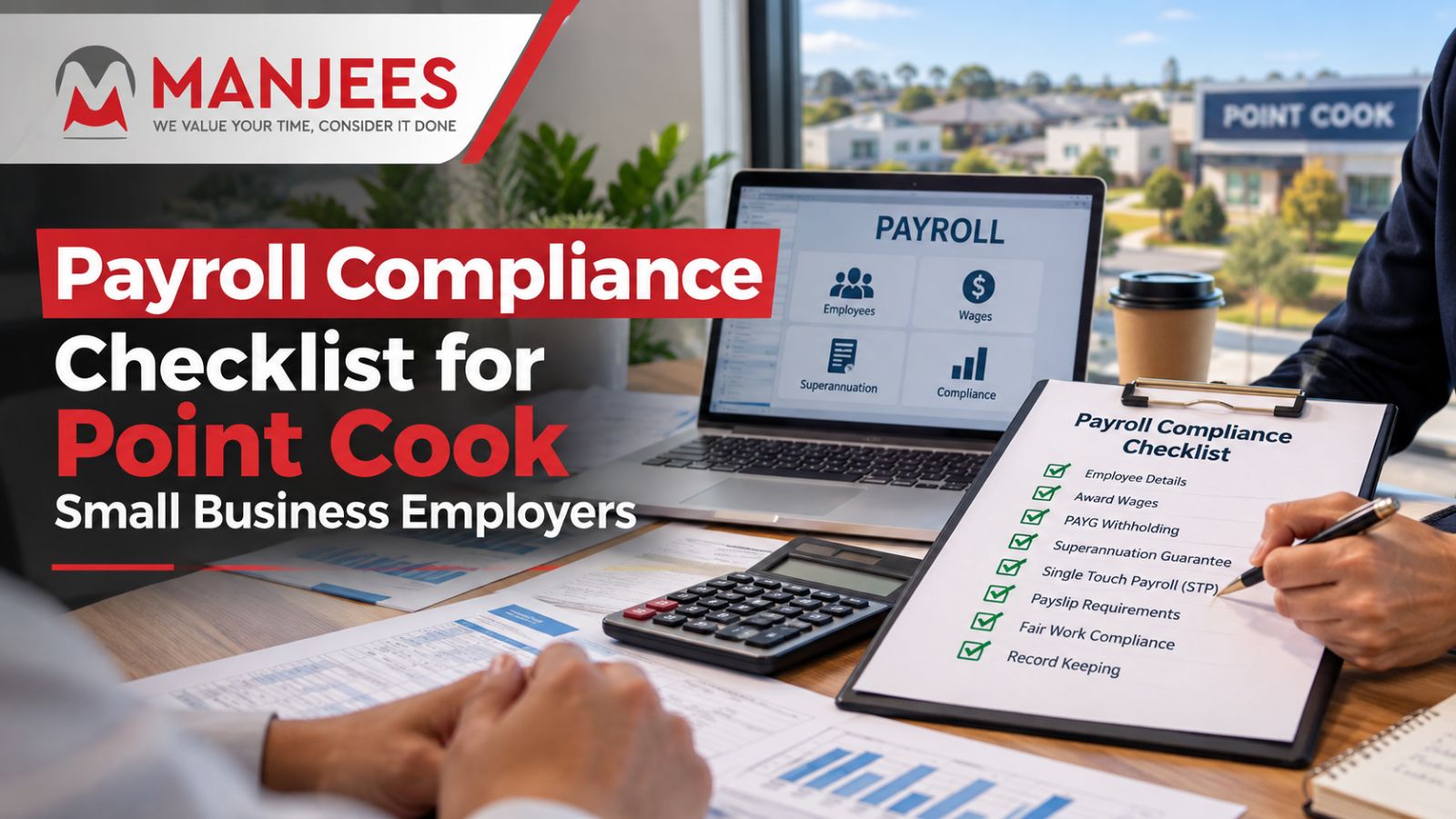
Managing payroll involves more than paying employees on time. Small business employers need to calculate wages correctly, apply the right award rates, manage superannuation, issue compliant payslips and report payroll information to the Australian Taxation Office (ATO). Missing one of these responsibilities can lead to incorrect payments, employee disputes or compliance problems.
For local businesses, Payroll Services Point Cook compliance for small business starts with having a clear, repeatable process. Whether you employ your first staff member, manage a growing team or run a business with casual and part-time employees, a practical checklist can help you keep accurate records and meet your obligations.
This guide explains the key payroll requirements Australian small business employers should review, the common mistakes to avoid and the practical steps that can make payroll easier to manage.
Why Payroll Compliance Matters for Small Businesses
Payroll affects several parts of a business at once: employee satisfaction, cash flow, tax reporting, superannuation and workplace obligations. Even a small payroll error can become difficult to resolve if timesheets, leave records or payment details are incomplete.
For example, imagine a Point Cook café employing full-time staff, part-time team members and casual weekend workers. Each employee may have different working hours, leave entitlements and applicable pay conditions. If the owner processes everyone using the same assumptions, weekend penalties, casual loading or overtime may be calculated incorrectly.
A reliable payroll process helps employers:
- Pay employees accurately and on the agreed pay cycle.
- Apply the correct award, classification and employment conditions.
- Report payroll information to the ATO.
- Meet superannuation and payslip obligations.
- Keep records that can be checked if a question or dispute arises.
- Identify errors early and correct them with a clear audit trail.
Payroll compliance is not just an end-of-month task. It should be built into the regular way a business manages its employees.
Payroll Services Checklist for Point Cook Employers
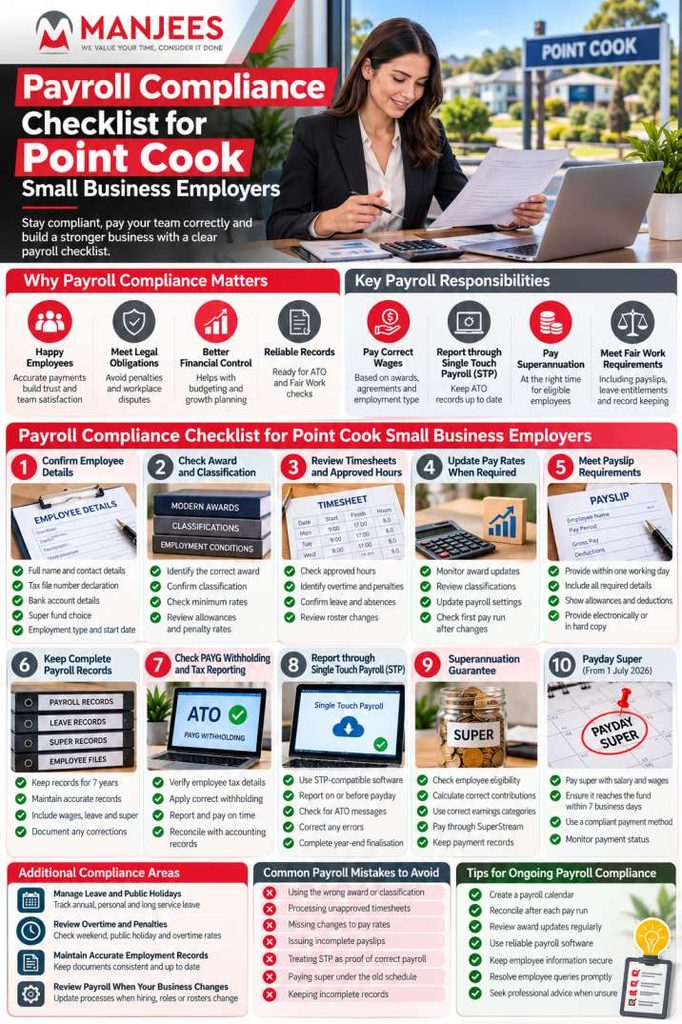
Use the following checklist when setting up a payroll process or reviewing an existing one. The exact obligations depend on your workforce, industry, employment arrangements and the rules that apply to your business.
1. Confirm each employee’s details
Before processing the first payment, collect and check the information needed to manage employment and payroll correctly.
Your onboarding checklist should cover:
- The employee’s full legal name and contact details.
- Tax file number declaration information or the applicable tax details.
- Bank account details for wage payments.
- Superannuation fund choice and required fund information.
- Employment type, such as full-time, part-time or casual.
- Start date, position and relevant employment documents.
- Applicable award or enterprise agreement, where relevant.
- Ordinary hours, agreed work pattern and pay arrangements.
Keep employee information secure and limit access to people who need it for legitimate business purposes.
2. Identify the correct award and classification
One of the most important payroll checks is confirming which industrial instrument applies to each employee. Many Australian employees are covered by a modern award or enterprise agreement. Others may be award-free but remain entitled to applicable minimum standards.
Do not choose an award based only on the business name or the employee’s job title. Consider the industry, the work actually performed, the employee’s duties and the relevant award coverage rules.
Check the employee’s classification and whether the arrangement affects:
- Minimum ordinary rates.
- Ordinary hours and rostering.
- Overtime and penalty rates.
- Casual loading.
- Allowances and leave loading.
- Breaks and minimum engagement periods.
An employee’s duties may change as a business grows. Review their classification when responsibilities change, not just when they are hired.
3. Check timesheets and approved hours
Accurate payroll starts with accurate records of time worked. Establish a consistent process for employees to submit their hours and for an authorised person to review them before payroll is finalised.
Check for:
- Missing shifts or incomplete timesheets.
- Overtime and additional hours.
- Weekend and public holiday work.
- Unpaid meal breaks and other relevant breaks.
- Approved leave and absences.
- Changes to rosters or agreed hours.
For example, a part-time employee might normally work weekday shifts but cover a weekend shift during a busy period. That change could affect the applicable pay treatment under their award or agreement. The payroll person should confirm the correct treatment rather than automatically applying the employee’s usual rate.
4. Review pay rates whenever requirements change
Pay rates and workplace conditions can change following annual wage reviews, changes to awards, changes in employee classification or changes to employment arrangements.
Build a regular review into your payroll calendar. When a change takes effect, confirm the correct implementation date and check which employees are affected.
A useful review process includes:
- Identifying the applicable award or agreement.
- Checking updated minimum rates and conditions.
- Reviewing employee classifications.
- Updating payroll settings and pay codes.
- Checking the first pay run after the change.
- Correcting any underpayment identified.
A salary arrangement should not automatically be treated as proof that all award entitlements have been met. Some awards have specific rules for annualised wages, including record-keeping and reconciliation requirements.
Compliance Checklist for Wages, Payslips and Records
Correct payment is only one part of payroll compliance. Employers also need to provide appropriate payment information and retain reliable employment records.
5. Meet payslip requirements
Employees must generally receive a payslip within one working day of being paid. Payslips can be provided electronically or in hard copy, provided the required information is included.
Review each payslip for:
- Employer and employee details.
- Payment date and the period covered.
- Gross and net payment amounts.
- Relevant pay rates and hours, where required.
- Separately identifiable loadings, allowances, bonuses or penalty payments.
- Deductions and their required details.
- Superannuation contribution information, as applicable.
The information must accurately reflect the payment and entitlements for the relevant period. A payslip generated by payroll software is not automatically compliant if the underlying employee settings or pay codes are wrong.
6. Keep complete payroll records
Employers generally need to keep employee time and wage records for seven years. Records should be accurate, legible, accessible and maintained in English. They must not be false or misleading, and corrections should be documented appropriately.
Depending on the employment arrangement, relevant records may include:
- Hours worked and overtime.
- Wages, pay rates and deductions.
- Leave taken and leave balances.
- Superannuation contributions.
- Employment terms and changes to arrangements.
- Relevant termination records.
- Records required for annualised wage arrangements.
Create a consistent filing system so records can be retrieved quickly. If a staff member asks about a payment from a previous period, you should be able to trace the calculation back to the timesheet, approved leave, applicable pay conditions and payroll report.
7. Check PAYG withholding and tax reporting
Employers may need to withhold tax from employee payments and report the relevant information to the ATO. The amount withheld depends on the employee’s circumstances and the applicable tax rules.
Your payroll process should include checks that:
- Employee tax details are recorded correctly.
- Withholding settings are current.
- Payments are recorded in the appropriate payroll categories.
- Withheld amounts are reported and paid by the relevant deadlines.
- Payroll records reconcile with accounting records and bank transactions.
Do not estimate withholding based on what an employee received in a previous job or on assumptions about their personal tax position. Use current ATO guidance and appropriate payroll calculations.
8. Complete Single Touch Payroll reporting
Single Touch Payroll (STP) allows employers to report payroll information to the ATO through compatible payroll software. STP reporting generally takes place on or before payday, with specific arrangements applying to certain circumstances, including some closely held payees.
For small businesses, a practical STP checklist includes:
- Confirming that the payroll system supports the required reporting.
- Checking employee details and pay categories.
- Reviewing gross payments, tax withheld and super-related reporting.
- Submitting the report at the required time.
- Reviewing software or ATO messages that identify errors.
- Correcting inaccurate year-to-date information.
- Completing the required end-of-year finalisation process.
STP reporting does not replace the obligation to calculate wages correctly or meet workplace requirements. It reports payroll information; it does not automatically establish that the underlying calculation is correct.
Superannuation Guarantee and Payday Super
9. Check superannuation eligibility and calculations
Superannuation needs its own review within the payroll process. Employers should confirm which employees are entitled to super support, identify the relevant earnings and calculate contributions using the applicable rules.
Check that:
- Employee fund details are correct.
- The correct earnings categories are included.
- Payroll settings reflect current superannuation requirements.
- Contributions are calculated correctly.
- Payments reach the employee’s fund within the required timeframe.
- Contribution records reconcile with payroll reports and payment confirmations.
Super calculations can be affected by the type of payment, the employee’s circumstances and the rules that apply to the relevant period. Do not assume that every payment category is treated identically for super purposes.
10. Update your process for Payday Super
From 1 July 2026, Payday Super changed the timing of superannuation guarantee payments. Employers are required to pay super at the same time as salary and wages, with contributions generally needing to reach the employee’s super fund within seven business days of payday, subject to applicable exceptions and extended timeframes.
Review your procedures for:
- Calculating super during each pay run.
- Initiating contributions promptly after payroll is processed.
- Using an appropriate SuperStream-compliant payment method.
- Checking employee fund details and resolving rejected payments.
- Monitoring contribution status rather than relying only on payment initiation.
- Retaining records that demonstrate when contributions were processed and received.
If a contribution fails or fund details are incorrect, investigate it promptly. A payment instruction alone may not demonstrate that the obligation has been met.
Fair Work Compliance for Small Business Employers
11. Manage leave and public holiday payments correctly
Leave management is closely connected to payroll. Approved leave must be recorded and processed according to the employee’s employment type, applicable workplace instrument and relevant legislation.
Your leave checklist should include:
- Annual leave accruals and approved leave taken.
- Personal or carer’s leave for eligible employees.
- Parental leave and other applicable leave entitlements.
- Long service leave requirements relevant to Victoria.
- Public holiday entitlements and any applicable penalty rates.
- Correct treatment of leave when employment ends.
Keep leave records consistent with timesheets and payroll reports. If a worker changes from part-time to full-time employment, review how the change affects their hours, leave balances and payroll settings.
For Victorian employers, long service leave is an additional area to check. The applicable rules can depend on the employee’s service history and circumstances, so avoid relying on a generic payroll setting without confirming the relevant requirements.
12. Review overtime, allowances and penalty rates
Overtime and penalty rates can be difficult to calculate because the rules depend on the applicable award or agreement, the hours worked and the circumstances of the shift.
Before approving payroll, check whether employees worked:
- Beyond their ordinary hours.
- On weekends or public holidays.
- Outside specified ordinary working hours.
- In conditions that attract a relevant allowance.
- Under a roster or arrangement with special requirements.
A common problem occurs when a manager approves a timesheet but does not identify the type of hours worked. Payroll may then treat every hour as an ordinary hour.
For example, a small business employee may cover a public holiday shift. The payroll team should check the applicable workplace instrument and confirm the correct treatment before processing the payment.
Practical Payroll Services Strategies for Growing Businesses
A payroll checklist works best when it becomes part of a repeatable business process. The following practices can help Point Cook employers reduce avoidable errors and manage payroll more consistently.
13. Create a payroll calendar
Set a calendar for every recurring payroll task, including:
- Timesheet submission and manager approval.
- Payroll processing and payment authorisation.
- STP reporting.
- Superannuation processing and follow-up.
- Leave balance reviews.
- Award rate and classification checks.
- Record reconciliation and year-end finalisation.
Assign responsibility for each step. In a small business, one person may perform several tasks, but each responsibility should still be clearly defined.
14. Reconcile payroll after each pay run
A payroll reconciliation checks whether the amounts processed agree with the underlying records and payments.
Compare:
- Approved timesheets with hours processed.
- Gross wages with the payroll report.
- Net wages with the bank payment file.
- PAYG withholding with payroll records.
- Superannuation liabilities with contribution records.
- Leave movements with employee balances.
Investigate unexpected differences before they accumulate. If a mistake is found, document what happened, correct the records and arrange any required payment or reporting adjustment.
Do not silently change historical records without maintaining an appropriate correction trail. Clear documentation helps explain the reason for an adjustment and supports accurate future reporting.
15. Use payroll software carefully
Payroll software can automate calculations, generate payslips and support STP reporting. However, it relies on accurate setup and regular maintenance.
Before relying on the system, check that:
- Award and employee settings are appropriate.
- Pay categories are mapped correctly.
- Superannuation settings reflect current requirements.
- Leave accruals and balances are configured properly.
- Reporting features are up to date.
- User access is restricted appropriately.
- Backups and record-retention arrangements are suitable.
When legislation or an award changes, do not assume every setting has updated correctly. Review the relevant changes, confirm how the software handles them and test the first affected pay run.
16. Review payroll when the business changes
Payroll requirements can change when a business hires staff, expands opening hours, introduces weekend trading or changes employees’ duties.
Schedule a payroll review when:
- A new employee starts.
- An employee changes classification or employment type.
- Working hours or rosters change significantly.
- The business introduces a new pay arrangement.
- An award or minimum entitlement changes.
- A payroll error or employee query reveals a process weakness.
These reviews are especially helpful for small businesses where the original payroll process may have been designed for only one or two employees.
Common Payroll Compliance Mistakes to Avoid
Even a well-intentioned employer can make mistakes when payroll tasks are rushed or responsibilities are unclear.
| Common mistake | Practical way to prevent it |
|---|---|
| Using an incorrect award or classification | Review the employee’s duties and applicable workplace instrument. |
| Processing unapproved timesheets | Require manager approval before each pay run. |
| Missing changes to minimum pay rates | Schedule regular award and rate reviews. |
| Issuing incomplete payslips | Use a checklist based on current Fair Work requirements. |
| Treating STP as proof that payroll is correct | Review the underlying calculations and records separately. |
| Paying super under an outdated schedule | Update the process for Payday Super and monitor fund receipts. |
| Keeping incomplete records | Maintain organised, accessible records for the required retention period. |
| Correcting errors without documentation | Record the error, correction, reason and any related payment or reporting action. |
A further misconception is that small businesses can ignore payroll requirements because they employ only a few people. Business size does not remove the need to meet applicable employee entitlements, reporting obligations and record-keeping rules.
How Accounting Services Point Cook Can Support Payroll Administration
Payroll connects with bookkeeping, cash-flow planning, tax reporting and financial record management. When these processes are disconnected, business owners may spend extra time reconciling different records or investigating inconsistencies.
Accounting Services Point Cook can be relevant when a business needs help maintaining consistent financial records alongside its payroll administration. Depending on the scope of the engagement, support may include reviewing payroll reports, reconciling wage expenses, organising records and coordinating relevant tax or reporting information.
Manjees Accounting and Taxation Services can be contacted to discuss the business’s accounting and payroll-related requirements. Before engaging any service, clarify which tasks are included, who is responsible for payroll approvals, how employee information is protected and how errors or urgent payroll questions will be handled.
The employer remains responsible for meeting its legal obligations, even when payroll processing is delegated. Make sure the business retains appropriate oversight of employee records, pay calculations, reporting and payments.
Expert Tips for Maintaining Payroll Compliance
Use these practical habits to keep the process manageable:
- Review the first pay run carefully. Check the calculations, employee details, pay categories and reporting before assuming the setup is correct.
- Keep evidence for every adjustment. Retain the supporting timesheet, approval or explanation for changes to a payment.
- Check changes before they take effect. Review award updates, employment changes and reporting requirements early enough to update the payroll process.
- Resolve employee queries promptly. Compare the payslip with the original records and explain the outcome clearly.
- Monitor superannuation payments. Check whether contributions reach the correct fund, rather than assuming the process is complete when a payment is initiated.
- Review payroll access regularly. Employee pay and tax details are confidential, so only authorised people should access them.
- Seek clarification when a rule is unclear. Use official ATO and Fair Work resources or obtain appropriate professional advice rather than relying on assumptions.
A short review after every pay run is often more useful than waiting until the end of the financial year to identify recurring errors.
Conclusion
A reliable payroll process gives Point Cook small business employers a clearer way to manage wages, employee records, tax reporting, workplace entitlements and superannuation. The most important steps are to confirm the correct award and classification, check hours before each pay run, issue accurate payslips, retain complete records and keep up with reporting and payment changes.
With payroll compliance for small business in Point Cook, consistency matters more than complicated administration. A documented checklist, regular reconciliation and prompt correction of errors can help employers maintain better records and respond more confidently when questions arise.
For businesses that want to review their payroll and accounting processes, Manjees Accounting and Taxation Services invites Point Cook business owners to make an enquiry. Call the business using its published contact number or complete its website enquiry form to discuss your requirements and determine what support may be suitable.
Frequently Asked Questions
1. What does payroll compliance involve for a small business in Point Cook?
Payroll compliance involves meeting the applicable obligations for employee wages, tax withholding, superannuation, STP reporting, payslips and employment records. Employers may also need to apply award rates, overtime, leave entitlements and penalty payments. The exact requirements depend on the employees and workplace arrangements. A recurring checklist helps ensure these responsibilities are reviewed throughout the year.
2. How often should a small business review its payroll process?
Review payroll during every pay cycle, including timesheets, payment calculations, reporting and relevant superannuation steps. A broader review should also take place when an employee’s duties change, a new worker joins, workplace requirements are updated or an error is identified. Regular checks help prevent small problems from becoming repeated mistakes.
3. What are the payslip and record-keeping requirements in Australia?
Employers generally need to issue payslips within one working day of paying employees and keep required employee records for seven years. Payslips must include prescribed details about payments, deductions and other relevant information. Employment records should be accurate, accessible and properly maintained. Employers should consult current Fair Work guidance to confirm the requirements that apply to their circumstances.
4. What changed with Payday Super in 2026?
From 1 July 2026, employers generally need to pay superannuation guarantee contributions at the same time as salary and wages. Contributions must generally reach the employee’s super fund within seven business days of payday, subject to applicable exceptions. Businesses should update their payroll calendar, payment arrangements and reconciliation process to reflect the new timing rules. The ATO’s Payday Super guidance should be checked for the current requirements.
5. Can an accountant help a Point Cook business manage payroll records?
An accountant or suitable payroll professional may assist with organising financial records, reviewing payroll reports, reconciling wage expenses and coordinating related reporting tasks, depending on the agreed scope of work and their qualifications. Employers should clarify responsibilities before engaging support and retain oversight of employee entitlements and required payments. For businesses considering assistance, Manjees Accounting and Taxation Services can be contacted to discuss their specific needs.